
Concrete is one of the most widely used construction materials in the world. It is strong in compression, cost-effective, and easy to produce. However, traditional concrete has one major weakness: it is brittle. Once cracks form, they can quickly grow and lead to sudden failure.
To solve this problem, engineers developed steel fiber reinforced concrete (SFRC). By adding small steel fibers into the mix, concrete becomes stronger, tougher, and much more resistant to cracking.
Today, SFRC is widely used in applications such as industrial flooring, highways, bridge decks, tunnels, and airport pavements. But an important question remains:
How do steel fiber dosage and fiber type influence concrete performance?
In this article, we will explain everything in a simple and practical way.
What Is Steel Fiber Reinforced Concrete?
Steel fiber reinforced concrete is made by adding short, discrete fibres d'acier into conventional concrete. These fibers are evenly distributed throughout the material.
You can think of it like this:
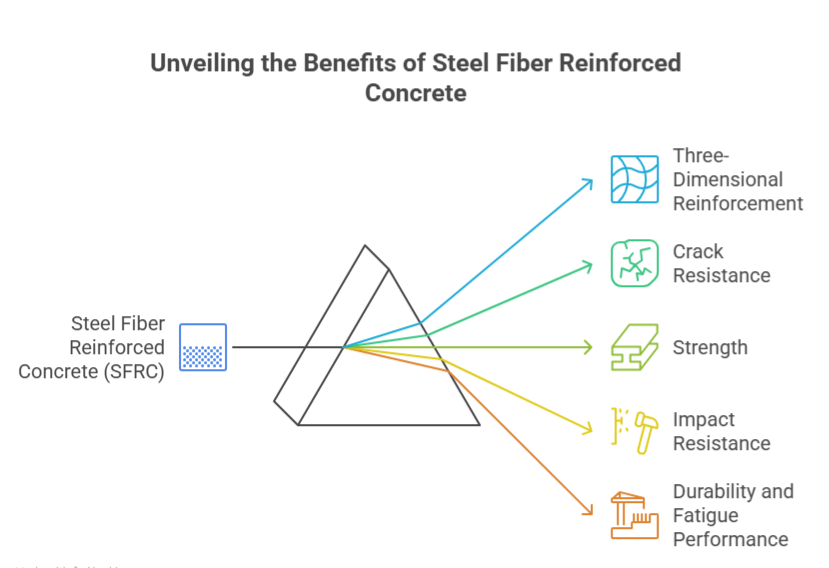
Instead of relying only on large reinforcing bars, SFRC creates a three-dimensional reinforcement network inside the concrete.
When cracks begin to form, steel fibers act like tiny bridges. They hold the cracked sections together and prevent the cracks from spreading quickly. This significantly improves the overall behavior of the material.
Compared to ordinary concrete, SFRC offers:
- Meilleure résistance aux fissures
- Higher flexural and tensile strength
- Improved impact resistance
- Enhanced durability and fatigue performance
Does Higher Steel Fiber Dosage Always Mean Better Performance?
One of the most common questions in practice is:
Should we add as much steel fiber as possible?
The short answer is: Performance improves with fiber dosage, but only up to a certain point.
As the amount of steel fiber increases, most mechanical properties of concrete improve. However, the level of improvement varies depending on the type of strength.
1. Compressive Strength
Steel fibers have a relatively small effect on compressive strength. The increase is usually modest. This is because concrete is already strong under compression, and fibers mainly work in tension zones.
2. Flexural and Tensile Strength
This is where steel fibers make a big difference.
As fiber dosage increases, flexural and tensile strength improve significantly. In some cases, the flexural strength can be several times higher than that of plain concrete.
This happens because fibers carry tensile stress after cracks begin to form. Instead of failing immediately, the material continues to bear loads.
3. Shear Strength
Steel fibers also enhance shear resistance, often more than tensile strength. They help maintain the integrity of the material under complex stress conditions, which is very important in real structures.
4. The Practical Limit
Although higher fiber dosage improves performance, excessive dosage can cause problems such as:
- Poor workability
- Fiber clustering (balling effect)
- Higher material cost
In real projects, fiber dosage is usually optimized to balance performance and practicality.
How Steel Fibers Improve Crack Resistance
The most important benefit of steel fibers is crack control.
In ordinary concrete, cracks form easily under tension and expand rapidly. Once a crack appears, failure often follows quickly.
Steel fibers change this behavior completely.
When a crack forms, fibers that cross the crack begin to carry the load. They hold the crack faces together and slow down crack growth. This mechanism is known as the bridging effect.
As loading continues, fibers do not break immediately. Instead, they are gradually pulled out from the concrete matrix. This process absorbs energy and delays failure.
As a result:
- Crack initiation is delayed
- Crack propagation is slowed down
- Structural integrity is maintained longer
This is why SFRC performs much better in demanding conditions.
Toughness: The Real Value of Steel Fibers
Many people focus only on strength, but the real advantage of steel fibers lies in robustesse.
Toughness refers to the ability of a material to absorb energy before failure. Plain concrete has very low toughness. It fails suddenly without warning.
Steel fiber reinforced concrete behaves differently.
After cracking, the material can still deform and carry loads. This gives it a more ductile behavior, meaning it fails gradually instead of suddenly.
This property is extremely important in applications such as:
- Industrial floors subjected to repeated loads
- Bridges exposed to dynamic forces
- Airport pavements under heavy impact
- Seismic-resistant structures
By improving toughness, steel fibers make concrete safer and more reliable.
Why Steel Fiber Type Matters
In addition to dosage, the type of steel fiber plays a crucial role in performance.
Different fiber shapes provide different levels of bonding and anchorage within the concrete.
Common Types of Steel Fibers
- Straight fibers
- Crimped (wave-shaped) fibers
- Hooked-end (bow-shaped) fibers
- Dumbbell-shaped fibers
Performance Comparison
Among these types, fibers with mechanical anchorage perform better.
Dumbbell-shaped and hooked-end fibers are especially effective. Their ends are designed to lock into the concrete, making them harder to pull out.
Dumbbell-shaped fibers typically offer the best performance. Their enlarged ends provide strong anchorage, while the middle section effectively transfers stress.
Hooked-end fibers also perform very well due to their curved ends.
In contrast, straight fibers have weaker bonding and are more likely to slip out, resulting in lower reinforcement efficiency.
Crimped fibers fall somewhere in between, offering moderate improvement.
Simple Analogy
If we compare fibers to nails:
- Straight fibers are like smooth nails
- Hooked and dumbbell fibers are like nails with barbs
The latter are much harder to pull out, which is why they perform better.
Practical Recommendations for Applications
In real engineering projects, choosing the right steel fiber solution requires balancing performance, cost, and workability.
A moderate fiber dosage is usually sufficient to achieve significant improvement. Extremely high dosage is rarely necessary and may create practical challenges.
For high-performance applications, such as bridge decks or airport pavements, fibers with strong anchorage—like hooked-end or dumbbell-shaped—are recommended.
For general applications, such as floors or pavements, more cost-effective options may be considered, depending on project requirements.
Proper mixing and dispersion are also critical. Even the best fibers cannot perform well if they are not evenly distributed in the concrete.
Effect on Shrinkage and Durability
Shrinkage is one of the main causes of cracking in concrete. As concrete dries, it loses moisture and shrinks, creating internal stress.
Steel fibers help reduce this problem.
They form a network inside the concrete that restrains deformation. This reduces shrinkage stress and limits crack formation.
At the same time, fibers prevent small cracks from growing into larger ones. This improves long-term durability and extends the service life of structures.
For projects where durability is critical, such as infrastructure or industrial facilities, this benefit is particularly valuable.
Questions fréquemment posées
1. What does steel fiber do in concrete?
Steel fiber improves concrete by increasing its crack resistance, toughness, and durability. It helps control crack formation and prevents cracks from spreading, allowing the structure to maintain strength even after initial cracking.
2. Does adding more steel fiber increase concrete strength?
Adding more steel fiber generally improves performance, especially flexural and tensile strength. However, excessive fiber dosage can reduce workability and increase costs, so an optimized dosage is recommended for best results.
3. Which type of steel fiber is best for concrete?
Dumbbell-shaped and hooked-end steel fibers typically provide the best performance. Their enhanced anchorage allows them to bond more effectively with concrete, improving crack resistance and toughness compared to straight or crimped fibers.
4. How much steel fiber should be added to concrete?
The optimal amount depends on the application, but most projects use a moderate dosage range. This level provides a good balance between improved mechanical performance and workable concrete consistency.
5. Does steel fiber replace rebar in concrete?
Steel fiber can partially replace traditional reinforcement in some applications, such as industrial floors and pavements. However, in structural elements requiring high load-bearing capacity, it is usually used together with rebar rather than as a full replacement.
6. How does steel fiber improve crack resistance?
Steel fibers act as bridges across cracks. When cracks form, the fibers hold the concrete together and slow crack growth. This reduces the risk of sudden failure and improves long-term durability.
7. Is steel fiber concrete more durable than normal concrete?
Yes, steel fiber reinforced concrete is generally more durable. It has better resistance to cracking, impact, fatigue, and shrinkage, which helps extend the lifespan of structures.
8. What are the main applications of steel fiber reinforced concrete?
Steel fiber concrete is widely used in industrial floors, road pavements, bridge decks, tunnels, airport runways, and precast elements where high durability and crack control are required.
Conclusion
Steel fiber reinforced concrete is not just stronger—it is smarter.
Instead of simply increasing strength, steel fibers improve how concrete behaves under stress. They control cracks, enhance toughness, and extend durability.
The key factors that determine performance are fiber dosage and fiber type. Higher dosage generally improves properties, but must be optimized. Fiber shape significantly affects bonding and overall effectiveness.
Understanding these factors helps engineers, contractors, and material suppliers make better decisions and achieve better results in real projects.
As the demand for durable and high-performance construction materials continues to grow, steel fiber reinforced concrete will play an increasingly important role in the future of construction.


