
Concrete is one of the most widely used construction materials in the world. It is strong in compression, durable, and relatively affordable. However, traditional concrete also has a well-known weakness: it is brittle and has low tensile strength. This means it can easily crack when exposed to tension, shrinkage, or temperature changes.
To solve this problem, engineers often add reinforcing materials to concrete, which is elyaf takviyeli beton. One effective solution is Glass Fiber Reinforced Concrete (GFRC). By mixing special glass fibers into the concrete matrix, the material becomes stronger, more flexible, and more resistant to cracking.
In this article, we will explain what glass fiber reinforced concrete is, how it works, its main benefits, and where it is commonly used in construction projects.
What Is Glass Fiber Reinforced Concrete?
Glass Fiber Reinforced Concrete, often abbreviated as GFC or GFRC, is a type of composite material made by adding alkali-resistant glass fibers into cement-based concrete.
These fibers are distributed throughout the concrete mix. Instead of relying only on traditional reinforcement such as steel bars, the fibers help strengthen the material internally.
When cracks start to form in concrete, the fibers act like tiny bridges across the crack. They hold the material together and prevent the crack from spreading quickly.
Because of this mechanism, GFRC offers several advantages compared with ordinary concrete:
- Better crack resistance
- Higher tensile and flexural strength
- Improved durability
- Greater impact resistance
For this reason, GFRC has become an important material in modern construction and architectural design.
Main Components of Glass Fiber Reinforced Concrete
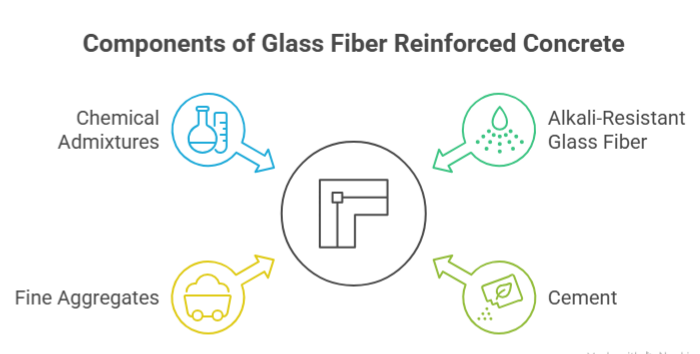
Glass fiber reinforced concrete is made from several key materials that work together to produce its unique performance.
Alkali-Resistant Glass Fiber
The most important component of GFRC is alkali-resistant (AR) glass fiber.
Concrete contains cement, which creates a highly alkaline environment. Ordinary glass fibers can degrade in such conditions. To solve this problem, AR glass fibers are specially designed with chemical additives that improve their resistance to alkaline attack.
These fibers usually have the following characteristics:
- Yüksek gerilme mukavemeti
- High elastic modulus
- Good chemical stability
- Strong bonding with cement matrix
Because of these properties, they can effectively reinforce the concrete structure over time.
Cement
GFRC typically employs low-alkali cement or specialty cement as the cementitious binder. Lower alkali content reduces corrosion of the glass fibers, thereby enhancing material durability.
The choice of cement type also influences concrete strength, shrinkage behavior, and overall stability.
Proper selection of cement helps ensure the long-term performance of glass fiber reinforced concrete.
Fine Aggregates
Unlike traditional concrete that uses coarse aggregates, GFRC typically uses fine sand or silica sand.
Smaller aggregate particles help the fibers distribute more evenly throughout the mixture. This uniform distribution is important for achieving consistent reinforcement throughout the material.
If aggregates are too large, they may interfere with fiber dispersion and reduce the reinforcing effect.
Chemical Admixtures
Various chemical admixtures are often added to improve the performance and workability of GFRC. These may include:
- Plasticizers or superplasticizers
- Stabilizers
- Çelik lifler
- PP elyaf
- Crack-control additives
These admixtures help improve the flowability of the mix, allowing fibers to disperse more evenly while maintaining good mechanical properties.
How Glass Fibers Strengthen Concrete
The reinforcing mechanism of glass fibers in concrete is relatively simple but very effective.
When concrete is exposed to stress, small microcracks may begin to form inside the material. In ordinary concrete, these cracks can quickly grow and eventually cause structural failure.
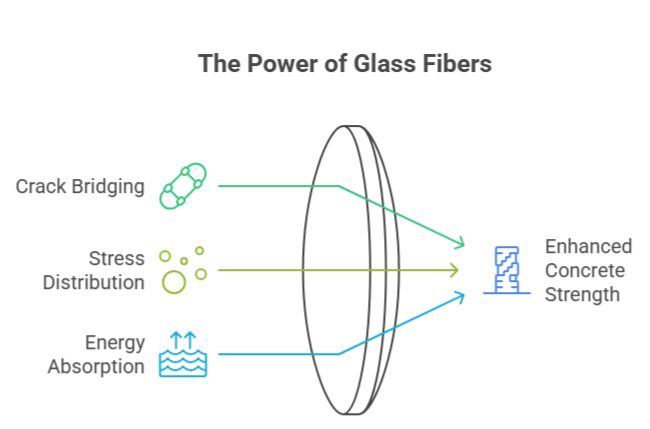
In glass fiber reinforced concrete, the fibers help control this process in several ways:
Crack Bridging
Fibers span across the crack and hold the two sides together.
Stress Distribution
The fibers distribute tensile stress throughout the material instead of concentrating it in one area.
Energy Absorption
When fibers pull out or break, they absorb energy that would otherwise cause the concrete to fail.
Because of these mechanisms, GFRC behaves differently from conventional concrete. Instead of sudden brittle failure, it shows better toughness and ductility.
Key Advantages of Glass Fiber Reinforced Concrete
- Excellent Crack Resistance
One of the biggest advantages of GFRC is its ability to control cracking.
Concrete often develops cracks due to drying shrinkage, temperature changes, or external loads. The presence of glass fibers helps limit the growth of these cracks, improving the overall durability of the material.
- Higher Flexural and Tensile Strength
Glass fibers significantly improve the eğilme dayanımı of concrete.
While conventional concrete performs well under compression, it is weak in tension. The fibers help compensate for this weakness by carrying tensile stresses and improving the structural performance.
- Improved Impact Resistance
Glass fiber reinforced concrete is also more resistant to impact and vibration compared with ordinary concrete.
The fibers absorb part of the energy during impact, reducing the likelihood of sudden failure. This makes GFRC suitable for structures exposed to dynamic loads.
- Lightweight Structural Elements
Another advantage of GFRC is that it allows the production of thin and lightweight components.
Because fibers provide internal reinforcement, structural elements do not need to be as thick as traditional concrete parts. This helps reduce overall structural weight and makes installation easier.
Construction Considerations for GFRC
To achieve the best performance, proper production and construction practices are essential when working with glass fiber reinforced concrete.
1. Fiber Distribution
Fibers must be evenly dispersed in the concrete mixture. Uneven distribution may cause weak zones in the material.
Good mixing techniques and proper equipment help ensure uniform fiber dispersion.
2. Mixing Time
Mixing time should be carefully controlled.
If mixing continues for too long, the fibers may break and lose their reinforcing ability. On the other hand, insufficient mixing may lead to fiber clumping.
3. Mix Design
The mix design must be optimized to balance workability, strength, and durability. Proper ratios of cement, sand, water, fibers, and admixtures are necessary to achieve the desired performance.
Common Applications of Glass Fiber Reinforced Concrete
Thanks to its excellent mechanical properties and design flexibility, GFRC is widely used in many construction applications.
Architectural Facades and Decorative Panels
One of the most common uses of GFRC is in architectural cladding and decorative elements.
Typical examples include:
- Exterior wall panels
- Decorative facade elements
- Architectural moldings
- Sculptural components
GFRC allows designers to create complex shapes while maintaining structural strength.
Urban Landscape and Municipal Projects
GFRC is also widely used in urban landscape construction.
Common applications include:
- Landscape structures
- Garden sculptures
- Urban furniture
- Decorative public installations
The material’s durability and weather resistance make it suitable for outdoor environments.
Altyapı ve İnşaat Mühendisliği
In infrastructure projects, glass fiber reinforced concrete can be used for:
- Structural repair and strengthening
- Water management structures
- Bridge components
- Road infrastructure elements
These applications benefit from the material’s improved crack resistance and durability.
Future Development of GFRC
As construction technology continues to evolve, glass fiber reinforced concrete is expected to play an even larger role in modern building systems.
Future research and development may focus on:
- Improving the durability of glass fibers
- Developing more efficient mix designs
- Reducing production costs
- Enhancing sustainability through eco-friendly materials
With ongoing innovations, GFRC will likely become an increasingly important material in the global construction industry.
Sonuç
Glass Fiber Reinforced Concrete (GFRC) is an advanced construction material that combines the strength of cement with the reinforcing capability of glass fibers. By distributing fibers throughout the concrete matrix, the material achieves better crack resistance, improved toughness, and enhanced durability.
Because of these advantages, GFRC is widely used in architectural facades, decorative structures, municipal projects, and infrastructure applications.
As the demand for stronger, lighter, and more durable construction materials continues to grow, glass fiber reinforced concrete will remain an important solution for modern engineering and building design.


