
Modern roads are expected to carry heavier traffic, withstand extreme temperatures, and maintain performance for many years. However, traditional asphalt concrete often faces challenges such as rutting in hot weather, cracking in cold climates, and moisture damage over time. To solve these problems, engineers increasingly use fiber-reinforced concrete mixtures.
Among different fiber types, basalt fiber has become a promising solution for improving asphalt pavement performance. Thanks to its high strength, excellent temperature resistance, and long-term durability, basalt fiber reinforced asphalt concrete offers a balanced improvement in both strength and flexibility.
In this article, we will explain what basalt fiber is, how it works in asphalt mixtures, and why it is becoming an important material in road construction.
Why Add Fiber to Asphalt Concrete?
Asphalt concrete is a viscoelastic material. This means it behaves differently depending on temperature and loading conditions. In high temperatures, it can soften and deform under traffic loads, leading to rutting. In low temperatures, it becomes more brittle and may crack. Water infiltration can further weaken the bond between asphalt binder and aggregates, causing premature damage.
Adding fiber to asphalt mixtures helps create a reinforced composite structure. The fiber distributes throughout the mixture and forms a three-dimensional network. This internal structure improves stability, reduces deformation, and enhances crack resistance.
Traditionally, lignin fiber and 폴리에스테르 섬유 have been used in asphalt mixtures. While these materials provide certain benefits, they also have limitations in high-temperature resistance, long-term durability, or environmental stability. As a result, mineral-based fibers such as basalt fiber are gaining more attention in the pavement industry.
What Is Basalt Fiber?
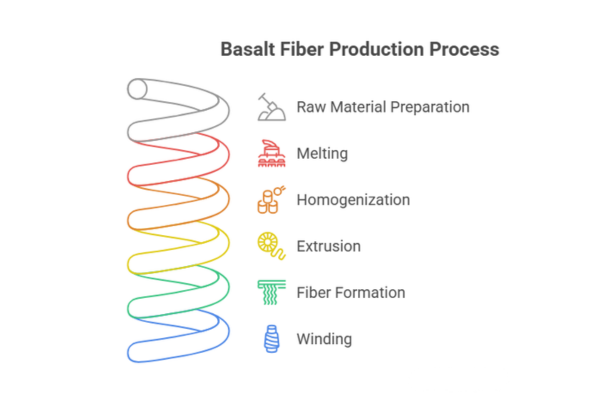
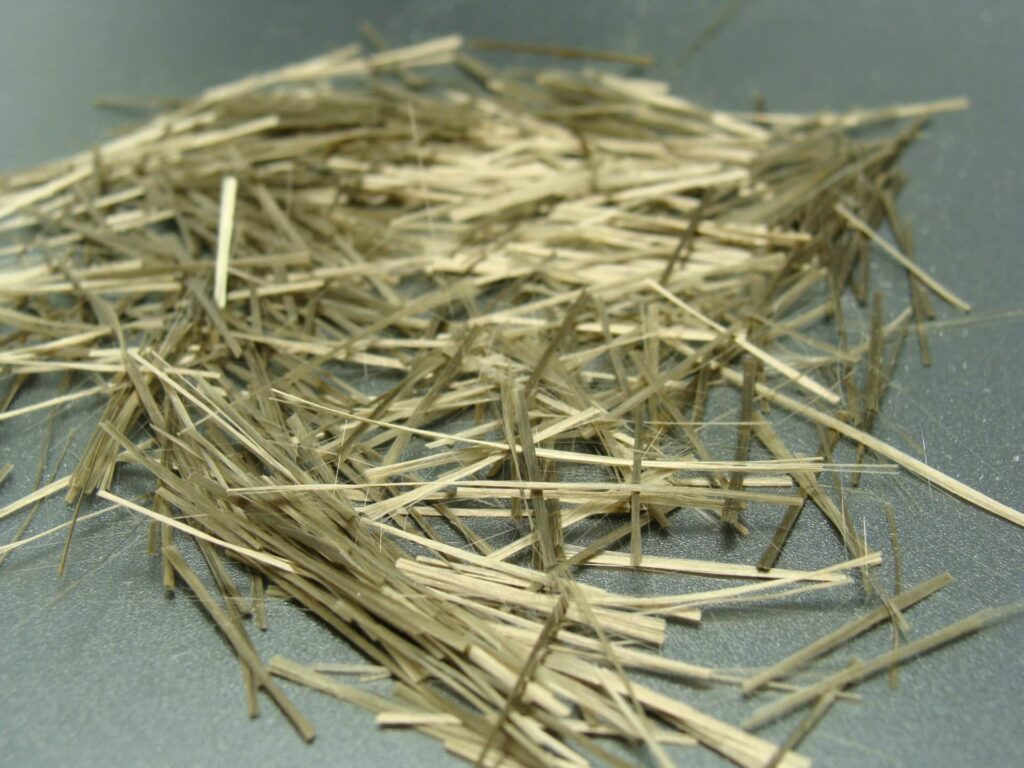
Basalt fiber is made from natural basalt rock. The rock is melted at high temperature and then drawn into continuous filaments. These filaments are cut into specific lengths for use in construction materials.
Because basalt fiber is made from natural mineral material, it offers several important advantages:
- 높은 인장 강도
- Excellent heat resistance
- Good chemical stability
- Strong durability
- Environmentally friendly composition
Compared with organic fibers, basalt fiber does not melt easily during asphalt mixing. Compared with older mineral fibers, it does not contain harmful substances. These features make it suitable for modern, sustainable road construction.
When mixed into asphalt concrete, basalt fibers disperse evenly and bond with the asphalt binder. The result is a reinforced structure that improves both strength and flexibility.
Key Benefits of Basalt Fibers in Concrete
Improving High-Temperature Performance
One of the biggest problems in hot climates is rutting. When asphalt softens under high temperature and repeated traffic loads, the surface can deform permanently. This not only affects driving comfort but also reduces safety.
Basalt fiber helps solve this issue by reinforcing the asphalt mixture internally. The fibers limit aggregate movement and increase the mixture’s resistance to flow deformation. This means the pavement can better maintain its shape even under heavy traffic and high surface temperatures.
For highways, urban main roads, and industrial areas where heavy trucks operate frequently, basalt fiber reinforced asphalt concrete offers stronger resistance to rut formation. Over time, this can reduce maintenance frequency and lower lifecycle costs.
Enhancing Low-Temperature Crack Resistance
In cold regions, ice melt often damages concretes. As temperatures drop, the material contracts. If the internal stress exceeds its tensile capacity, cracks form. Once cracks appear, water can penetrate and cause further damage.
Basalt fiber improves the flexibility and toughness of asphalt mixtures. The fiber network inside the material helps distribute stress more evenly. Instead of concentrating at one point, stress spreads across the structure. This reduces the risk of sudden cracking.
Because of this reinforcing effect, basalt fiber asphalt concrete performs better in regions with large temperature differences between seasons. It is especially suitable for bridge decks and high-altitude highways, where thermal stress is more severe.
Increasing Moisture Resistance and Durability
Water damage is another common cause of pavement failure. When water enters the asphalt structure, it weakens the bond between binder and aggregates. Over time, this can lead to stripping, raveling, and surface deterioration.
Basalt fiber has strong chemical stability and does not absorb excessive moisture. When incorporated into asphalt mixtures, it helps maintain structural integrity. The reinforced internal structure also improves cohesion, which enhances resistance to moisture-related damage.
In rainy climates, coastal areas, and freeze-thaw environments, improved water stability is critical. By strengthening the asphalt mixture from within, basalt fiber contributes to longer service life and more reliable pavement performance.
Balanced Improvement in Mechanical Properties
Road materials must not only resist deformation but also maintain adequate strength and flexibility. A material that is too stiff may crack easily, while one that is too soft may deform under load.
Basalt fiber provides a balanced improvement. It increases tensile strength while maintaining good elongation capacity. This combination of strength and toughness helps asphalt pavements absorb traffic loads without failing prematurely.
As a result, fiber-reinforced asphalt mixtures often show better structural stability under long-term traffic conditions. For contractors and road authorities, this translates into extended pavement life and improved cost efficiency.
Suitable for Different Asphalt Mixture Types
Basalt fiber can be used in various asphalt mixture structures, including dense-graded and stone matrix types. In both cases, the reinforcing effect remains effective.
In dense-graded mixtures, basalt fiber enhances cohesion and deformation resistance. In stone matrix asphalt, it works well with the aggregate skeleton structure, further stabilizing the mixture.
The key to achieving optimal performance is proper mix design and uniform fiber distribution. Fiber length, dosage, and mixing process should be selected based on project requirements. With correct application, basalt fiber can significantly upgrade overall pavement quality.
Environmental and Long-Term Benefits
Sustainability is becoming increasingly important in infrastructure development. Basalt fiber is produced from abundant natural rock and does not release harmful substances. Its durability reduces the need for frequent road repairs, which lowers material consumption and energy use over time.
By improving pavement lifespan, basalt fiber reinforced asphalt concrete supports long-term environmental and economic benefits. Fewer repairs mean less traffic disruption and reduced maintenance costs.
Why Choose Basalt Fiber for Road Construction?
As traffic demand continues to grow and climate conditions become more challenging, road materials must perform better than ever before. Basalt fiber reinforced asphalt concrete offers a practical solution by improving:
- High-temperature rutting resistance
- Low-temperature crack resistance
- Moisture stability
- Mechanical strength and toughness
- 장기적인 내구성
For road contractors, engineers, and material suppliers, basalt fiber provides a reliable way to upgrade pavement performance without complex changes to existing construction processes.
As a professional manufacturer of construction fibers, we supply high-quality basalt fiber designed specifically for asphalt reinforcement applications. Our products are engineered to ensure stable dispersion, strong bonding with asphalt binder, and consistent performance in various pavement structures.
If you are looking to enhance asphalt durability and extend pavement service life, basalt fiber reinforced asphalt concrete may be the solution your project needs. Feel free to contact us to learn more about product specifications, technical support, and customized fiber solutions for your next road construction project.
결론
Building roads that last is not just about using asphalt. It is about choosing the right materials to strengthen it from the inside. Basalt fiber offers a simple yet powerful way to make asphalt pavements more resistant to rutting, cracking, and moisture damage.
With its strong, stable, and temperature-resistant properties, basalt fiber helps roads stay in better condition for a longer time. For contractors and project owners looking for a practical way to improve pavement performance without complicating the construction process, basalt fiber reinforcement is a smart and reliable solution.


 KO
KO  EN
EN  AR
AR  ES
ES  FR
FR  RU
RU  PT
PT  ID
ID  JA
JA  TR
TR