
When people talk about materials, especially in engineering or manufacturing, the word “strong” gets thrown around a lot. But strength isn’t just one thing. It can mean how much pulling force a material can take, how much weight it can carry, how it behaves under pressure, or how long it lasts over time.
So when someone asks, “Is carbon fiber stronger than steel?”, the honest answer is:
👉 Yes, carbon fiber can be stronger than steel — especially in tensile strength — but it depends on how you measure strength and how the material is used.
In terms of قوة الشد (how well a material resists being pulled apart), carbon fiber is clearly ahead. Carbon fiber typically has a tensile strength of 3,500–7,000 MPa, while steel usually ranges from 400 to 2,600 MPa, depending on the grade.
But strength isn’t the only factor. Weight, durability, cost, temperature resistance, and real-world application all matter too. In this article, we’ll break things down in plain language, compare carbon fiber and steel side by side, and help you understand which material is actually “stronger” for your specific needs.
What Is Carbon Fiber?
Carbon fiber is not a metal. It’s a composite material, made by bonding thousands of ultra-thin carbon strands together using a resin (usually epoxy).
Each strand of carbon fiber is incredibly thin—about the size of a human hair—but when bundled and layered correctly, the result is a material that’s exceptionally strong and extremely lightweight.
Key properties of carbon fiber
Here’s why carbon fiber gets so much attention:
Very high strength-to-weight ratio
It’s strong without being heavy. That’s its biggest advantage.
Customizable performance
Engineers can control fiber direction, layer thickness, and resin type to tailor strength exactly where it’s needed.
Low density
Around 1.6 g/cm³, compared to steel’s 7.8 g/cm³.
Corrosion resistance
It doesn’t rust or corrode like steel.
Low thermal expansion
It doesn’t expand or shrink much with temperature changes.
Where carbon fiber is commonly used
Because of these properties, carbon fiber shows up in places where weight really matters:
- Aerospace structures and aircraft parts
- Automotive components (especially sports and electric vehicles)
- Bicycles, racing bikes, and sporting goods
- Wind turbine blades
- Industrial reinforcement and structural components
Carbon fiber is not cheap, and it’s not perfect, but when lightweight strength is the top priority, it’s hard to beat.

What Is Steel?
Steel is one of the most widely used materials in human history. It’s an iron–carbon alloy, sometimes mixed with other elements like chromium, nickel, or manganese to improve specific properties.
Steel may not sound as exciting as carbon fiber, but there’s a reason it’s everywhere.
Key properties of steel
Steel stands out for different reasons:
- Excellent overall strength
- Very good compressive strength
- High durability and toughness
- Handles heat extremely well
- Easy to shape, weld, and machine
- Highly recyclable
Steel is also predictable. Engineers know exactly how it behaves under stress, which makes it reliable for large-scale structures.
Where steel is commonly used
Steel dominates industries that need rigidity, mass, and long-term stability:
- Buildings and construction frameworks
- Bridges and infrastructure
- Heavy machinery and industrial equipment
- Cars, trucks, ships, and railways
- Tools, appliances, and consumer goods
Steel may be heavier, but it’s tough, affordable, and proven.
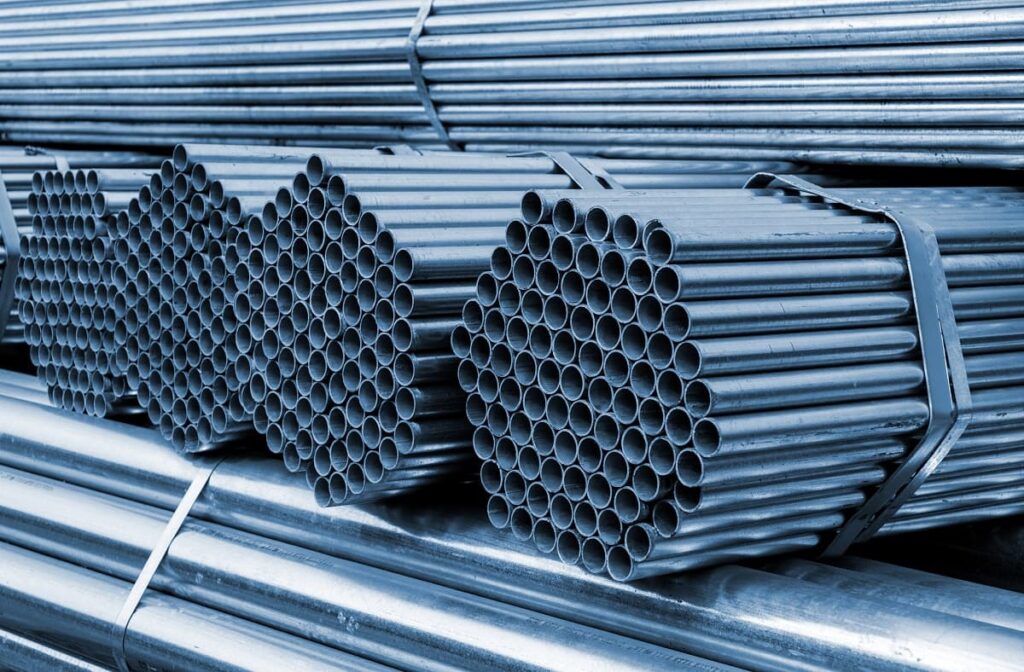
Carbon Fiber vs. Steel: Key Differences at a Glance
Before going deeper, let’s look at the big-picture differences.
| Property | Carbon Fiber | Steel |
|---|---|---|
| Strength focus | Tensile strength per weight | Strength per volume & compression |
| Density | ~1.6 g/cm³ | ~7.8 g/cm³ |
| Corrosion resistance | ممتاز | Prone to rust |
| مقاومة الحرارة | Moderate (needs coating) | ممتاز |
| التكلفة | High upfront | Low upfront |
| Manufacturing | Complex | Simple and mature |
| Typical use | Lightweight, high-performance | Heavy-duty, structural |
Weight & Density
Carbon fiber is far lighter than steel. Its density is about 1,500–2,000 kg/m³, while steel sits around 7,850 kg/m³—roughly five times heavier. This big weight difference leads to better fuel efficiency, easier handling, lower energy use, and less stress on other parts. That’s why carbon fiber is widely used in aerospace, EVs, and renewable energy systems.
المتانة
Carbon fiber does not rust and resists moisture, chemicals, and salt. Steel can corrode unless protected. Both materials handle fatigue well when properly designed, but steel performs better under sudden impacts, as it can bend without breaking. Carbon fiber is strong but more brittle and can be damaged by sharp impacts.
التكلفة
Carbon fiber is still expensive due to higher material and manufacturing costs. Steel is cheap, easy to source, and fast to produce at scale, which is why it dominates construction and infrastructure. In high-performance uses, however, carbon fiber can be cost-effective over time thanks to weight savings and low maintenance.
الأثر البيئي
Steel is highly recyclable with mature recycling systems, though energy-intensive to produce. Carbon fiber parts save energy during use and last a long time, but recycling is more challenging—though steadily improving.
Tensile Strength: What Does “Stronger” Really Mean?
When people say “carbon fiber is stronger than steel,” they’re usually talking about قوة الشد.
What Is Tensile Strength?
Tensile strength is how much pulling force a material can handle before it breaks.
Think of stretching a rope. The harder you pull, the closer it gets to snapping. Tensile strength tells you how much force it can take.
Carbon Fiber vs. Steel (Tensile Strength)
- Carbon fiber: ~3,500–7,000 MPa
- Steel: ~400–2,600 MPa
So yes — carbon fiber can handle more pulling force than steel.
But here’s the real advantage: carbon fiber does this while being much lighter.
This is why carbon fiber is so popular in aircraft and performance vehicles. You get massive strength without carrying extra weight.
Applications: Choosing the Right Tool
Choose carbon fiber when:
- Weight reduction is critical
- High tensile strength is needed
- Corrosion resistance matters
- Performance is more important than cost
Choose steel when:
- Compression and impact resistance matter
- Budget is limited
- High heat resistance is required
- Large-scale structural support is needed
This is why modern engineering often uses both.
Conclusion: So… Is Carbon Fiber Stronger Than Steel?
Yes — carbon fiber is stronger than steel in terms of tensile strength, and far lighter at the same time. That makes it incredibly powerful for the right applications.
But steel is still unbeatable in many areas: compression, impact resistance, heat tolerance, cost, and recyclability.
The real takeaway is this: The “stronger” material depends on how you define strength and where you plan to use it.
Smart material selection isn’t about choosing one over the other—it’s about understanding their strengths and using each where it makes the most sense.
If you’re building something that needs to be light, efficient, and high-performing, carbon fiber is hard to ignore. If you need toughness, stability, and affordability at scale, steel is still king.
And that’s why both materials will continue to shape our world—side by side.


 AR
AR  EN
EN  ES
ES  FR
FR  RU
RU  PT
PT  ID
ID  JA
JA  TR
TR  KO
KO